
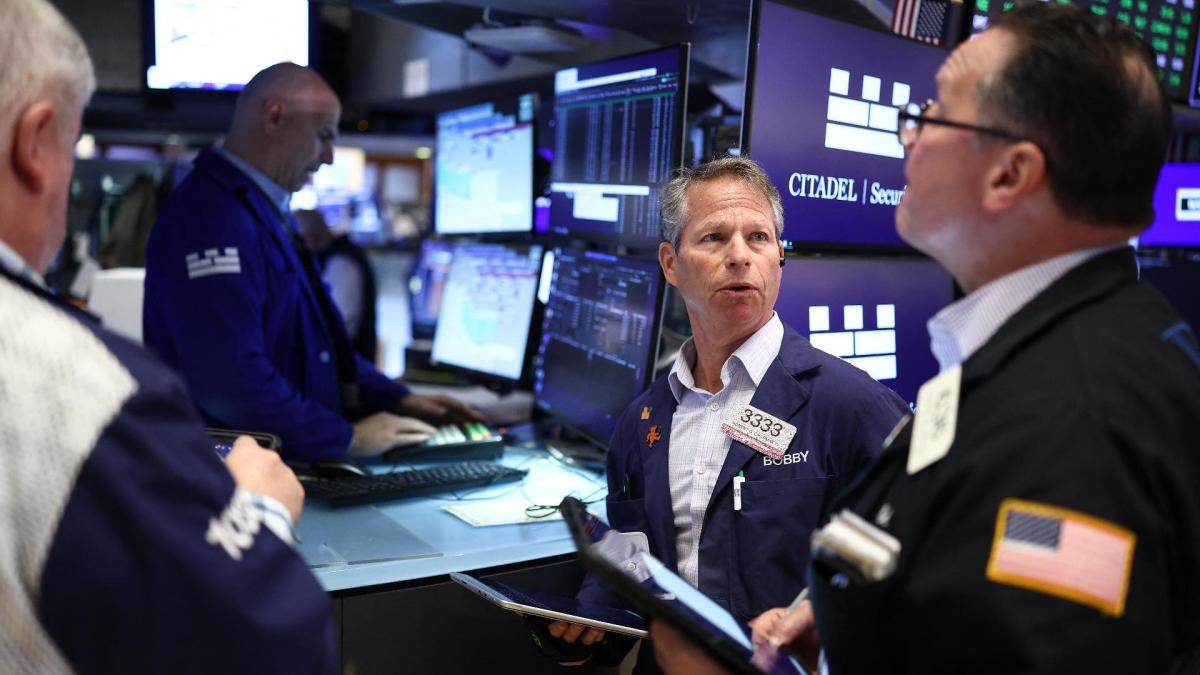
The stock market has had a tumultuous start to the year, and choppiness has only gotten worse of late.
Stock market investors continue digesting the effects of the Iran war, tariffs, inflation fears, and comments from the Fed.
However, Max Kettner, chief multi-asset strategist at HSBC, isn’t waiting for the dust to settle.
In an appearance on CNBC’s “Closing Bell,” Kettner said Monday’s S&P 500’s closing low of 6,612 is likely to hold as the near-term bottom, hailing it as the first legitimate buy signal since the chaotic “Liberation Day” stretch.
That’s a remarkably bold take, given how swiftly sentiment has soured since mid-February. But the strategist points to a convergence of technical and positioning indicators that historically precede sustainable market turns.
We have seen the S&P 500, Nasdaq, and Dow Jones on edge lately, but Kettner told CNBC that “the conditions are now aligning across the broader risk asset spectrum,” pointing to stocks and credit spreads as critical beneficiaries of the shifting landscape.
It’s a shift in tone that breaks a two-month stretch of panic selling, as the selling pressure finally appears to be exhausting itself.
Key takeaways from Kettner’s S&P 500 call
- Buy signal triggered: It’s the first “proper buy signal” for risk assets since Liberation Day, driven by a washout in discretionary positioning and hedging.
- S&P 500 bottom: Monday’s closing low of 6,112 is likely to hold as the near-term bottom.
- The common thread: Investors are now “heavily over-hedged across the board,” meaning selling pressure is likely exhausted.
- The big risk: A hot core CPI reading of 0.4% or 0.5% could push 10-year Treasury yields into the “danger zone” above 4.5%.
What’s really happening under the radar
The S&P 500’s average April gain since 1950 is a robust 1.46%, but as the last five years show, that “average” masks some serious volatility.
Here’s a look at how the index has performed in April over the last five years, based on Yahoo Finance.
- 2021: +5.24%, a robust surge, capping off a strong start to the year
- 2022: -8.80%, a brutal sell-off, the index’s worst April in over 50 years
- 2023: +1.46%, a modest gain that helped steady the ship
- 2024: -4.16%, a surprising decline that snapping a powerful Q1 rally
- 2025: -0.68%, a slight loss, as trade war uncertainty kept a lid on gains
March’s tape lays out clearly why Kettner flipped bullish.
The high-frequency labor market and consumer expenditure numbers came in strong, and employment avoided a plunge; retail sales were not crushed on the ground, according to Globe Street, and recession talk was just talk.
He says that in March, both the big-time algorithm-driven funds and human investors were heavily invested and didn’t pull back.
That essentially left no cushion when bad news hit, so when things turned south headline-wise, there was a rush to sell.
However, as of last week, things have changed.
More Wall Street
- Billionaire Dalio sends 2-words on Fed pick Warsh
- Top analyst bets these stocks will boost your portfolio in 2026
- Bank of America sends quiet warning to stock market investors
Internal models at HSBC have shown that put-call ratios have soared to heights last seen during big market downturns, skew indicators have flashed oversold signals on numerous indexes, and individual investor sentiment surveys underscored bearishness among individual investors at multi-month highs.
It’s also important to note that Kettner isn’t wandering into bullish territory alone.
In my last article, I discussed how a veteran market guru came to a strikingly similar conclusion.
Yardeni held firm on his year-end S&P 500 target of 7,700, a level that implies nearly 20% upside from current depressed valuations, according to Yardeni’s valuation models and earnings projections.
Triballeau/Getty Images
The CPI wild card that could blow it all up
Nevertheless, Kettner isn’t throwing caution to the wind.
The upcoming core Consumer Price Index (CPI) reading remains the single biggest near-term threat to this budding bullish setup.
According to HSBC’s inflation tracking models, a print of 0.4% or 0.5% wouldn’t be great news for recent momentum, as Kettner put it diplomatically.
Here’s where things get genuinely dicey. HSBC runs what Kettner calls a “danger zone” model, and the critical threshold sits at 4.5% on the 10-year Treasury yield (US10Y). Right now, as tracked by Bloomberg, yields are hovering only about 0.15% south of that line.
“We are currently only about 15 basis points away from this level, leaving what Kettner described as an uncomfortable margin for safety,” the strategist said.
If a hot inflation print pushes yields into that danger zone, Kettner warns that virtually nothing will offer protection.
According to HSBC’s cross-asset correlation models:
- Emerging markets would sell off alongside developed equities.
- Credit spreads would widen indiscriminately.
- Rates wouldn’t offer a haven (obviously).
- Equities would get hammered across sectors.
“Nothing works, whether it’s EM, whether it’s credit, whether it’s rates, whether it’s equities,” Kettner explained.
He added that such a scenario “will spell trouble indeed, really for the entire asset class spectrum except for the greenback.”
Related: 5-star analyst makes a bold call on Micron stock
