

In the early 1980s, while I grew up in a reasonably wealthy household, sneakers were something you purchased either at the beginning of the school year or when you wore out or outgrew your current pair.
The term “sneakerhead” wasn’t common yet, and while some sneakers (probably not the ones I wore) were cooler than others, they weren’t really a fashion statement yet. That cultural change, however, was coming; it just hadn’t reached Swampscott, Mass., quite yet.
“Most sneakerheads credit the advent of their subculture to the rise of athlete-endorsed shoes in the late ‘70s and early ‘80s. Converse’s Chuck Taylor All-Stars had dominated the basketball courts for decades — and brands like Puma and Adidas started to get in on the action,” according to National Geographic.
The explosive growth, however, traces back to 1985 and the emergence of Nike’s Air Jordan partnership with Michael Jordan.
“What transformed sneaker culture into a true phenomenon was the 1985 release of Nike’s Air Jordan 1s. In 1984, Michael Jordan was a talented rookie who had yet to play in a professional game. Despite that, Nike — better known then as a running shoe company — saw Jordan as the future of their brand and signed him to a five-year, $2.5 million endorsement deal,” the website reported.
Sneakerheads, sneaker collecting, performance-based sneakers, and regular old sneakers are different things. Consumers are still buying shoes, but increasingly buying shoes they perceive as necessary, useful, or versatile, while postponing discretionary purchases.
That has proven to be bad news for Zumiez.
Zumiez sees sneaker sales drop
Zumiez, which describes itself as a “leading specialty retailer of apparel, footwear, equipment and accessories for young men and women,” saw its net sales drop for the second quarter ended Aug. 1, 2026 by 2.5% to $209.0 million from $214.3 million in the second quarter ended Aug. 2, 2025. Comparable sales for the same period decreased 2.1%, according to an earnings release.
“Net loss in the second quarter of fiscal 2026 was $2.7 million, or $0.17 per share, compared to a net loss of $1 million, or $0.06 per share, in the second quarter of the prior fiscal year,” the company added.
CEO Rick Brooks blamed the declines at least partially on falling sneaker sales.
“Second quarter results came in below last year driven by weaker performance in the U.S., which was primarily driven by continued softness in footwear as well as lower traffic levels,” he said.
More Retail:
- Home Depot is making a big bet on cautious consumers
- Another state just banned a controversial retail pricing practice
- JPMorgan just flagged a slow-build food crisis
The drop was not isolated to one quarter.
“The footwear category has been the most significant headwind, accounting for 70% of the total U.S. sales decline from the prior year through that timeframe. Footwear has been challenged since the second quarter of 2025, and the year-over-year comparisons get easier as we head into the fourth quarter of this year,” Brooks said during the chain’s second-quarter earnings call.
He made it clear that Zumiez was trying to correct the problem.
“We are certainly trying a lot of different things. And we have some things that are working to offset, but it is not working at a level that is able to deal with the big brands that are trending down,” he said.
The company plans to respond by working with footwear partners and trying to bring more unique products to its stores.
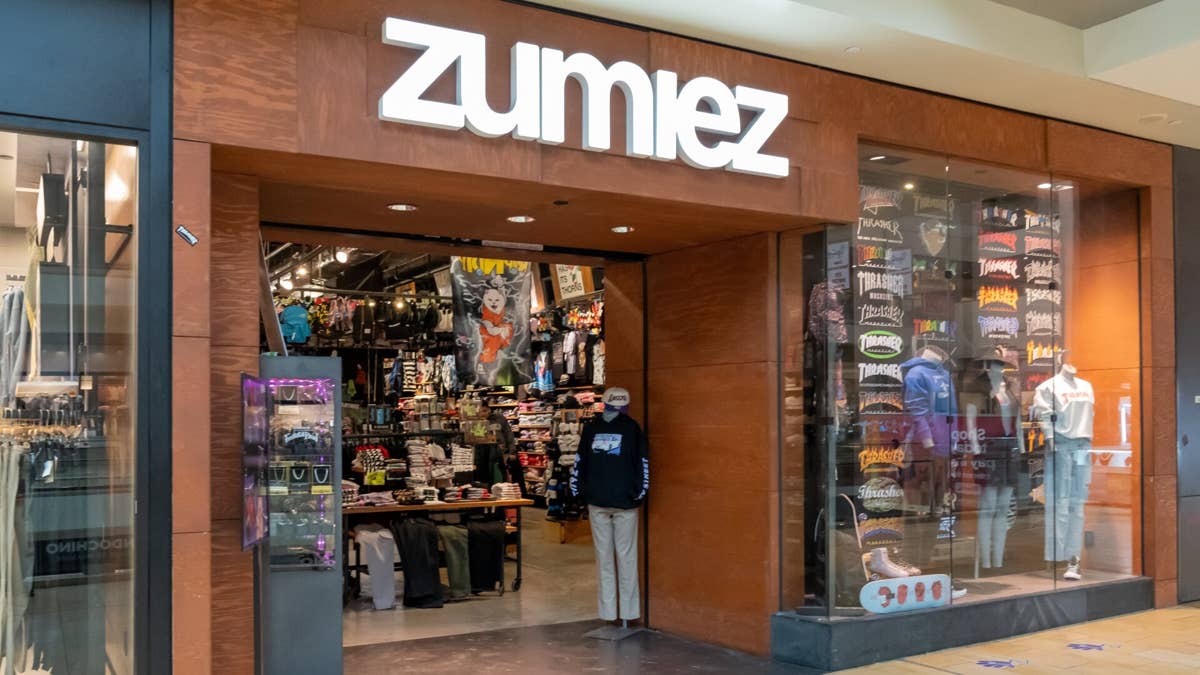
Shutterstock
Zumiez is closing stores
CFO Christopher Work shared the company’s plans to close some underperforming stores.
“We plan to close approximately 16 stores during fiscal 2026, including 10 in North America and 6 internationally,” he said during the earnings call.
Brooks noted the drop in transactions, which could be related to fewer customers visiting its stores. That trend has been unfolding for a while.
“Zumiez experienced a -37% change in visits in May 2025 compared to August 2024,” according to data from Placer.ai.
Traffic for the brand dropped while overall mall visits, where many Zumiez stores are located, grew.
“Shopping mall foot traffic continued to grow in July, with visits up 0.5% year over year at outlet malls, 4.3% at indoor malls, and 5.1% at open-air shopping centers — extending the sector’s positive momentum into the second half of the year,” according to Placer.ai.
Customers also spent more time at the mall.
“Visit duration grew at all three mall formats in July, reversing a decline that had persisted since February. Average visit durations were up 0.6% year over year at outlet malls in July, 0.2% at OASCs, and 2.7% at indoor malls,” the data showed.
U.S. shoe sales are complicated
Shoe sales aren’t shrinking but strengths in some areas have covered up weaknesses in others.
“The U.S. footwear industry delivered modest dollar growth during the first half of 2026, with total sales increasing +1%, compared to the same period last year,” according to Circana. “While consumers remained selective in their discretionary spending, higher average selling prices (ASP) continued to offset weaker demand reflected in a decline in units sold.”
Basically, people are buying the shoes they need for athletic and hobby reasons, but being more selective with other purchases.
“Performance footwear remained the industry’s standout growth engine in the first half, generating +6% dollar growth coupled with an increase in units sold. Running shoes continued to lead gains, with category dollar and unit sales both climbing +13%. Cross-training, golf, volleyball, and other activity-based categories also posted gains as consumers continued investing in products that support movement, wellness, and active lifestyles,” Circana shared.
RTM Nexus CEO Dominick Miserandino explained why these trends are bad for a lifestyle retailer that caters to teens.
“Parents will still replace the shoes their kids outgrow, but the second or third pair is easy to postpone. That is where Zumiez gets squeezed: The customer may still like the product, but liking it and needing it are two very different things when the family budget is tight,” he told TheStreet.
ALSO READ: Amazon Prime members get a warning about the $139 price
