

T-Mobile and Verizon have been gaining momentum in attracting new internet customers; however, competition has just intensified with a new rival in the broadband market.
In recent months, both companies have benefited from a growing trend of consumers switching from traditional internet services offered by cable operators to lower-priced fixed wireless and fiber internet offerings from wireless carriers.
Amid this trend, T-Mobile reportedly added roughly 520,000 broadband customers in the second quarter of 2026, according to data from research and consulting firm Recon Analytics. Verizon gained about 348,000 internet customers during the quarter, its latest earnings report revealed.
In a May report from RCR Wireless News, Jeff Moore, telecom analyst and principal of Wave7 Research, said the “U.S. broadband duopoly of cable and telcos is fading” as “increased competition from carriers and alternative providers is giving consumers more choices, wider availability, easier setup, and lower prices.”
Cricket Wireless introduces 5G home internet service
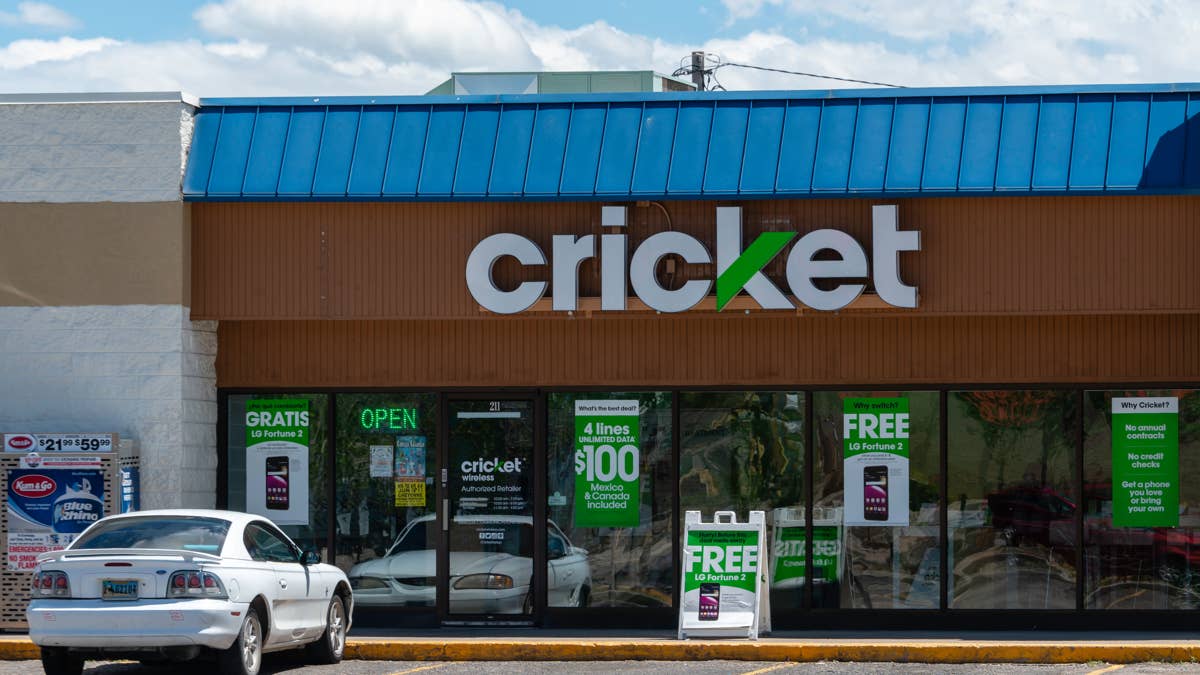
As T-Mobile and Verizon benefit from shifting consumer behavior, Cricket Wireless, which is owned by AT&T, has entered the broadband market by launching 5G home internet service (a fixed wireless internet service).
Cricket 5G Home Internet officially launched on Sept. 16, according to a new press release. The carrier states that the offering “simplifies connectivity with predictable pricing, no annual contracts, and plan taxes included” in the monthly price. It also runs on AT&T’s network.
The plan is $65 per month, and if new customers bundle it with Cricket Wireless, it is $75 per month. However, existing Cricket Wireless customers can add Cricket 5G Home Internet for $45 per month (with the $5 autopay discount activated).
Related: T-Mobile adds monthly fee to a new iPhone feature for customers
The plan offers “unlimited data for streaming, gaming, browsing and everyday household connectivity.” It has a typical download speed of 90-300 Mbps, an upload speed of 8-30 Mbps, and a latency of 30-65 milliseconds.
Also, Cricket Wireless states that no installation appointments are needed, as customers can set up the service themselves in minutes using the myCricket Internet App.
“Customers are looking for fast, reliable internet that’s simple to buy, easy to understand, and backed by a brand they trust,” said Angela Rittgers, president of Cricket Wireless, in the press release. “With Cricket 5G Home Internet, we’re delivering the internet you need at the value you deserve while removing the complexity; it’s just the smarter way to stay connected.”
RiverNorthPhotography / Getty Images
Cricket Wireless joins a growing push for affordable internet
The move announced by Cricket Wireless comes at a time when the big three carriers, T-Mobile, AT&T and Verizon, have been revamping their internet offerings this year.
For example, in March, AT&T launched its OneConnect plan, which costs $90 per month and offers customers combined wireless and 1-gig fiber home internet service (with speeds up to 1,000 Mbps).
In May, T-Mobile refreshed its fiber internet offerings with a new Fiber 300 Mbps plan that starts at $45 per month. It also lowered the price of its Fiber 1 Gig plan from $65 per month to $60 per month, and while its Fiber 2Gbps plan remained at $70 per month, a promotion is no longer required to secure that price.
More Telecom News:
- T-Mobile excludes 2 generous customer perks from new phone plans
- Comcast eyes acquisition of 33-year-old rival amid struggles
- Spectrum makes significant decision as customer losses mount
Verizon took a similar step as AT&T when it launched its Verizon One plan in June, which offers customers combined mobile and home internet service for $70 per month.
Recently, internet providers have increasingly focused on offering greater value and affordability as consumers become more sensitive to price increases.
A survey from PCMag in August found that 47% of U.S. consumers saw their monthly internet bills increase over the last 12 months.
The average estimated price hike was $16.58 per month, reflecting an almost $200 year-over-year increase. In extreme cases, approximately 11% saw price increases exceeding $30 per month.
Amid this trend, 36% said they are unhappy with their internet service and are contemplating switching providers.
“So few of us have a true choice when it comes to picking an ISP (internet service provider),” said Eric Griffith, a senior editor covering broadband at PCMag, in the survey release.
“Providers coast on their regional monopolies or duopolies,” he added. “That lack of competition means you’re over a barrel, paying high prices for service that seldom improves in any noticeable way.”
Related: Verizon scales back a perk that keeps prices low for customers
