

With less than two months to go before the November midterm elections, data centers have emerged as an unexpected political fault line in the US, bringing Democrats and Republicans together around concerns that were barely part of the national political debate two years ago.
The facilities that underpin the artificial intelligence boom are increasingly becoming campaign targets as voters raise concerns about electricity costs, water consumption, land use, tax incentives and the impact of large industrial projects on their communities.
The political shift is visible in campaign advertising.
More than $31 million has been spent this year on political advertisements mentioning data centers, according to AdImpact data reported by CNN.
In August, more than 8% of all campaign spending on broadcast television went toward ads involving data centers or AI infrastructure, compared with less than 1% last year.
More than 99% of this year’s spending on such advertisements has opposed AI infrastructure projects.
That puts an unusual political spotlight on an industry that has become central to the business case for generative AI.
Technology companies are committing hundreds of billions of dollars to new computing infrastructure, while developers, utilities and equipment suppliers are racing to meet demand from companies including Microsoft, Amazon, Meta, Google and Oracle.
But the physical infrastructure required to sustain that expansion is increasingly running into a political problem: communities have to approve the land, power and infrastructure needed to build it.
Why are Americans across parties opposing data centers?
A nationally representative survey conducted by the University of Pennsylvania’s Annenberg Public Policy Center between June 16 and July 19 found that 61% of US adults somewhat or strongly opposed construction of new data centers in their area, up from 49% in a survey conducted four months earlier.
Opposition crossed party lines.
Some 69% of Democrats, 54% of Republicans and 53% of independents opposed new local data centers, according to the survey of 1,320 US adult citizens.
Data centers can require huge amounts of electricity, creating concerns about the cost of new generation and grid upgrades.
Water use has become another point of contention, particularly in areas facing drought or other water constraints.
Residents have also raised concerns about noise, land use, property values and the amount of permanent employment generated relative to the size of the facilities.
The debate has also become a vehicle for broader anxiety over AI.
For some voters, opposition to a data center offers a tangible way to push back against technological changes that otherwise appear difficult to influence.
The development of AI models is largely controlled by technology companies, but data centers require land-use approvals, electricity connections, environmental reviews and local permits.
That makes the infrastructure easier for residents and politicians to challenge.
Brookings researchers Nicol Turner Lee and Darrell M. West have described the development as a significant shift in public opinion, writing that the public has moved from a “cautiously optimistic view of data centers to outright opposition.”
“The focus on data centers, in one of this year’s most competitive Senate races, demonstrates dramatic shifts in public opinion and the high stakes going into the midterm elections,” Lee and West wrote.
“The public has gone from a cautiously optimistic view of data centers to outright opposition, and this rising negativity poses challenges for technology firms, the digital economy, and policy discussions concerning the future of data center moratoriums and business investments. It is thus a political transformation that warrants close scrutiny by candidates, tech leaders, and election observers,” they said.
Republicans join the political rhetoric
The change in political rhetoric has been particularly striking among Republicans.
A Washington Post analysis of 4,300 social media posts and newsletters from politicians between July 2024 and mid-August 2026 found that Republican politicians had shifted sharply toward negative comments about data centers during the previous six months.
Democrats had made a similar shift earlier, becoming mostly negative in their public statements about data centers in June 2025.
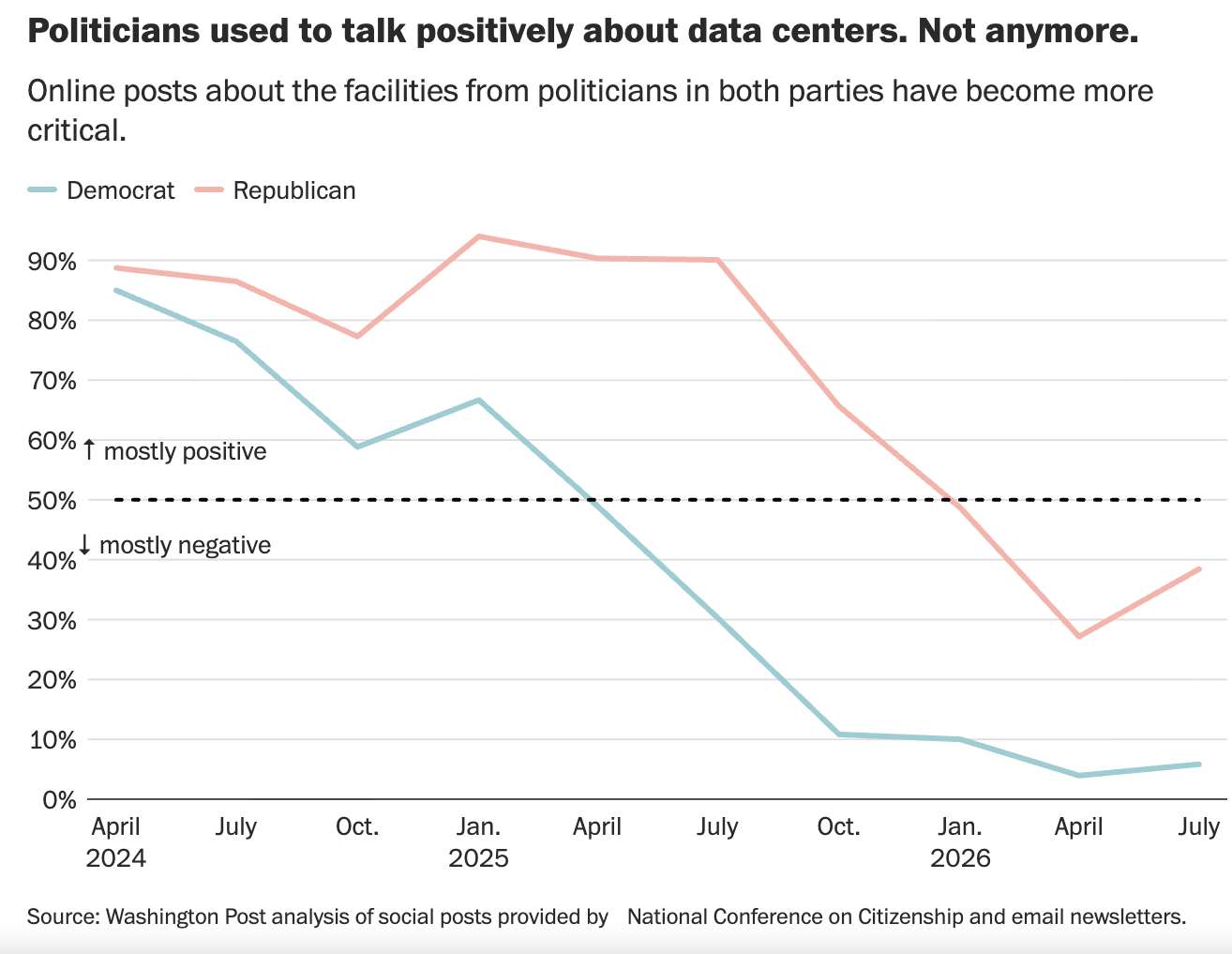
Source: Washington Post
In early 2024, politicians from both parties were more likely to celebrate new facilities for the investment, jobs and economic activity they promised.
As opposition grew, the political emphasis moved toward electricity costs, subsidies, tax breaks, land use and impacts on rural communities.
Tiffany’s volte face in Wisconsin ahead of elections
The result has been a series of candidates changing or refining positions that had previously been more supportive of the industry.
In Wisconsin, Republican Rep. Tom Tiffany supported speeding up data center construction at the federal level earlier this year and called the technology exciting.
By May, as he campaigned for governor, he was promising to repeal state tax breaks that attract data centers.
Tiffany is now using the issue against Democratic opponent David Crowley, referring to him in campaign advertising as “data center David Crowley.”
Crowley had previously said Wisconsin could become a major AI and data center hub, describing the opportunity as one that could help the state become a leading technology center.
Democratic candidate Francesca Hong has separately called for a moratorium on data centers.
Ohio sees Brown’s relentless attacks on Husted over data centers
Ohio has become one of the most closely watched examples of the political shift.
Republican Sen. Jon Husted is facing former Democratic Sen. Sherrod Brown in a closely watched Senate race, with data centers becoming a central point of contention.
Brown has repeatedly attacked Husted over his support for AI infrastructure and tax incentives, calling him “data centers’ best friend.”
Husted, meanwhile, has introduced legislation aimed at preventing residents from bearing the cost of new data center infrastructure.
His position had evolved from earlier enthusiasm for data centers, although his campaign says he has consistently supported allowing local communities to decide whether they want new projects.
Ohio’s Republican Gov. Mike DeWine has also suspended new applications for data center tax exemptions while the state considers legislative changes.
Texas faces its own data center backlash
Texas has spent years positioning itself as a destination for technology investment, with Republican Gov. Greg Abbott previously describing Texas as the “epicenter of AI development.”
But concerns about electricity demand and local impacts have pushed data centers into the middle of the gubernatorial and Senate races.
Democrat Gina Hinojosa has criticized Abbott for being too supportive of data centers and argued that technology development needs to be balanced against community concerns.
Abbott has subsequently backed an “audit” of data center development while his administration studies the impact of the projects.
The governor has also moved toward restrictions on some rural development and changes to tax incentives.
Pennsylvania shows how quickly positions can change
Pennsylvania Gov. Josh Shapiro has also shifted toward greater restrictions after spending years courting data center investment.
Shapiro’s Republican challenger, state Treasurer Stacy Garrity, accused him of “rolling out the red carpet” for developers.
On Aug. 18, Shapiro, considered a potential contender for the 2028 Democratic presidential nomination, signed an executive order requiring proposed data centers to comply with the state’s Responsible Infrastructure Development, or GRID, requirements.
The order also removed AI data center projects from a fast-track approval program.
Trump’s vehement support complicates opposing Republicans’ position
The one major political figure who has not moved is the one who matters most: Donald Trump.
Trump has repeatedly framed the infrastructure race as part of America’s competition with China and has argued that slowing construction could weaken US technological leadership.
“China could not be happier with this anti Data Center movement,” Trump wrote on social media on Aug. 31.
However, Trump has said Republicans running for office should be free to take different positions.
“If a Republican’s against a data center, that’s OK with me,” the president said in mid-August.
At the same time, Trump said that, generally, he would want data centers in his state because of the income, taxes, and jobs they could generate.
He has also issued stronger warnings about the consequences of communities rejecting the projects.
“The only reason that communities throughout the USA should not want Data Centers is if they want to end up being backwards and poor,” Trump wrote in another post.
Matt Levendusky, a University of Pennsylvania professor of political science and communication, described the bipartisan nature of the issue as unusual.
“The bipartisan reaction is really striking – you just don’t really see this on many issues any longer,” he said in a MarketWatch report.
It’s “an issue where there is widespread public opposition in a way we don’t see very much in our current political moment.”
How the data center plank could reshape future politics
The November elections will provide a test of how durable the opposition is as a political force.
A shift toward more moratoriums, audits, stricter permitting rules or changes to tax incentives could make the US data center pipeline slower and more expensive.
Brookings’ Lee and West have warned that if prominent supporters of data centers are defeated, politicians could become more willing to support moratoriums, pauses and audits, potentially slowing future development and creating challenges for AI investment.
“I’d be shocked if every 2028 candidate didn’t start to articulate plans for how they’ll handle AI, how they want to regulate it,” Levendusky said.
“This is going to be a part of our politics moving forward.”
The economic stakes extend beyond elections
At the same time, a political response that significantly slows construction could create another set of economic questions: how quickly can US companies expand AI capacity, how much will computing power cost, and what happens to the investment plans built around an assumption of abundant new infrastructure?
Microsoft, Amazon, Google, Meta, Oracle and other technology companies have committed enormous sums to data centers and related infrastructure.
The first quarter of 2026 alone saw at least 75 data center projects worth roughly $130 billion blocked or delayed because of opposition, according to Data Center Watch, a tracker associated with AI intelligence firm 10a Labs.
The figure was roughly equal to the number of projects blocked or delayed during all of 2025.
That does not mean all of those projects will be permanently cancelled.
Some can be redesigned, relocated or approved after developers and communities reach agreements.
But delays can still matter for companies whose growth plans depend on adding computing capacity quickly.
They also create risks for the companies that supply the infrastructure required to build data centers, including semiconductor manufacturers, electrical equipment companies, cooling-system providers, construction firms and utilities.
“Data-centre opposition is more of an emerging risk than an immediate pressure on AI-related stocks,” Gil Luria, head of technology research at DA Davidson, said earlier this year.
Logan Purk, a technology industry analyst at Edward Jones, has taken a more urgent view.
“I do think the difficulty is not fully baked in,” Purk said in a New York Times report earlier this year.
“If we assume tomorrow that data-centre construction stops because there’s no access to new power, the ripple effects across the semiconductor industry would be pretty substantial.”
The so-called picks-and-shovels companies — equipment and infrastructure suppliers whose fortunes are linked to the pace of data center construction — therefore face direct exposure to any prolonged slowdown.
The concerns were underscored by last week’s market selloff, which followed warnings about the risks posed by advanced AI and calls from industry leaders, including Anthropic CEO Dario Amodei, for more time to address those risks.
The post How the data center backlash is becoming a bipartisan issue in the 2026 US midterms appeared first on Invezz
